









Research & Development > Innovative Sources for SIMS
Potential Application Areas
Potential Application Areas Technical Publications
High Speed Ultra-Low Energy Dynamic SIMS (oxygen ions)
The higher brightness and lower energy spread of the Oregon Physics plasma source results in a figure-of-merit at the chromatic limit that is more than 40 times greater than a Duoplasmatron. Hence, in the absence of space charge limitations, compatible ion optics can expect to deliver up to 40x higher current for the same spot size at the low beam energies needed for depth profiling next generation ultra-shallow implants. Once space charge effects are considered for a 150eV oxygen beam, we still anticipate a 10x increase in beam current density and depth profiling speed for ion columns compatible with low energy beams.
High Resolution SIMS imaging (oxygen beam)
High resolution imaging at high beam energies and low beam currents is also generally limited by source brightness and energy spread. The enhanced performance of the Oregon Physics plasma source translates to a smaller ultimate spot size and 10-40x higher current density for a given spot size, when compared to a Duoplasmatron.
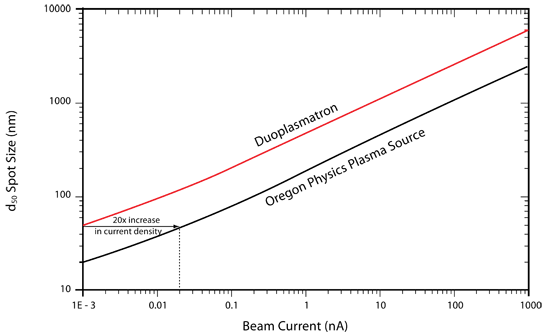
Oregon Physics Plasma Source compared to a Duoplasmatron.
The graph here shows calculated spot size versus beam current for our plasma source when compared with a Duoplasmatron with a reduced brightness, ßr of 400 Am-2sr-1V-1 and an energy spread of 10eV. With moderate ion column aberration coefficients (Cs=200mm, Cc=50mm), we would expect to see ~20x increase in current density at small spot sizes, as shown in the graph.
High Resolution Static SIMS with Xenon
With xenon, a single isotope can be selected with the potential for even smaller spot sizes. A 1pA /30keV132Xe+ spot would be as small as 15nm (d50 spot size – beam width containing half of the beam current) using optics with the above mentioned aberration coefficients.
Check back at this webpage in the second half of ’08 for news of further advancements in pulsed-TOF imaging performance.
High Resolution Pulse/Bunched SIMS
The usual balancing of chromatic blur and source imaging for an optimum spot size isn’t typically possible when bunching pulsed beams from a liquid metal ion source (LMIS) primary ion column. The low angular intensity of a LMIS, coupled with the broad energy distribution of a bunched beam results in a spot limited solely by chromatic blur. In this mode of operation, the LMIS brightness and small virtual source size lose their significance and consequently even a gallium LMIS is limited to ~1mm spot size for ~500pA pulse/bunched beams. The order of magnitude lower angular intensity of Au+ and Au3+ from the Gold-Germanium LMIS and Bi+ and Bi32+ from the Bismuth LMIS results in proportionately lower current for a given spot size.
Generally speaking, for beam currents of a few hundred picoamps or greater, the Oregon Physics plasma source can result in smaller spot sizes. For a LMIS the spot size will increase proportionately to (beam current)^xx, while for our plasma source the rate of increase is proportional to (beam current)^yy. Hence, once you need pulsed bunched beams of several 10’s of nA, the spot size of our source would be expected to be zz times smaller than a gallium LMIS.
Oregon Physics, LLC
19075 NW Tanasbourne Dr., Suite 150
• Hillsboro, OR 97124 USA
Phone: 503.601.0041 • Fax: 503-992-6710 • Email: info@oregon-physics.com
Web Design by Rareheron Web Design, Portland, OR